Roof and façade maintenance
Installing, cleaning or maintaining systems (like solar energy) that require roof or rooftop access.

00 Height safety
NR-35 sets the requirements for working at height safely. Learn when it applies and how LAMP installs anchor points and lifelines.
NR-35 (Norma Regulamentadora nº 35), issued by Brazil's Ministry of Labor, sets the minimum requirements and protective measures for working at height, covering the planning, organization and safe execution of any activity with a risk of falling. It covers everything from worker training to fall-protection systems — including anchor points and lifelines.
An anchor point is the spot (usually a fixed, identified metal fitting) where a worker connects their personal protective equipment (harness/lanyard) before climbing. A lifeline is a system that allows continuous movement with a secure connection along a path, instead of a single fixed point.
Real record of a rooftop anchor point installed by LAMP.
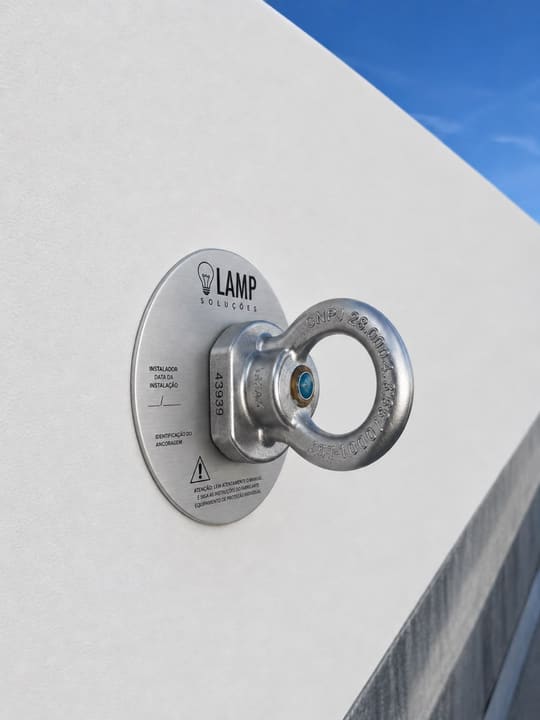
We install and mark anchor points and lifelines to NR-35, with an ID plate and a steel eyebolt sized for the working load — so the team that goes up on the roof or façade has somewhere safe to connect.
Installing, cleaning or maintaining systems (like solar energy) that require roof or rooftop access.
Any activity performed above ground level, with fall risk, on a construction site or industrial/commercial installation.
Inspecting SPDA systems, structures and installations on rooftops — a recurring activity, not a one-off.
What clients ask us most about working at height.
Work carried out above the lower level with a risk of falling — NR-35 itself sets the criterion. In practice many people underestimate it: roof maintenance, changing a high light fitting and reaching a water tank all enter the conversation.
It does. An anchorage system is structure: it has to be sized by an engineer for the loads involved and come with an ART. Anchorage improvised on a beam or a pipe run is the most expensive mistake we see in this area.
Yes, and it is not paperwork. The label is what lets a worker know, at the moment of clipping on, whether that point was engineered and verified — instead of trusting a ring that merely looks solid.
Yes. We design and install the anchor points and train the people who will use them. The right equipment with an untrained team is still a hazard.
See full contact details on the home page.
Engineers of record Page maintained by LAMP Soluções, electrical, mechanical and solar engineering, based in Itabaiana, Sergipe, Brazil. The company's engineers of record: Hertes Garcia, electrical engineer, and Aline Garcia, mechanical engineer — both registered with CREA.