Purpose
To design and certify the effectiveness of lightning rod systems and earthing grids, diverting and dissipating lightning currents safely into the ground, protecting the building structure, electrical and electronic equipment and human lives.

00 Lightning protection
SPDA (lightning protection system) protects your building — and the people inside it — from the effects of a lightning strike.
SPDA stands for Sistema de Proteção contra Descargas Atmosféricas — what most people call a "lightning rod system." It's a set of air terminals, conductors and a grounding system designed to capture a lightning strike and safely route it to the ground, keeping it from passing through the building's structure or internal electrical wiring. In Brazil, SPDA design and installation follow NBR 5419.
An essential part of an SPDA is its grounding system: to work correctly, it needs a grounding resistance within the project's parameters — which is why periodic continuity and resistance testing is part of the service, not an optional extra.
To design and certify the effectiveness of lightning rod systems and earthing grids, diverting and dissipating lightning currents safely into the ground, protecting the building structure, electrical and electronic equipment and human lives.
ABNT NBR 5419 (Parts 1 to 4) and NR-10.
Required by law. In Sergipe, SPDA is one of the fire safety measures listed in State Decree 40.637/2020, and the report is part of the fire department's Certificate of Regularity (ARCB, the state's equivalent of the AVCB), renewed every year.
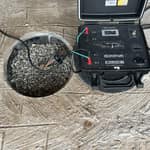
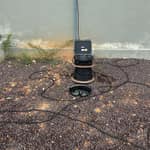
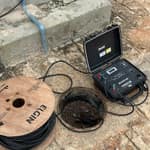
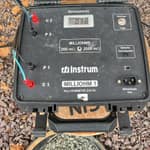
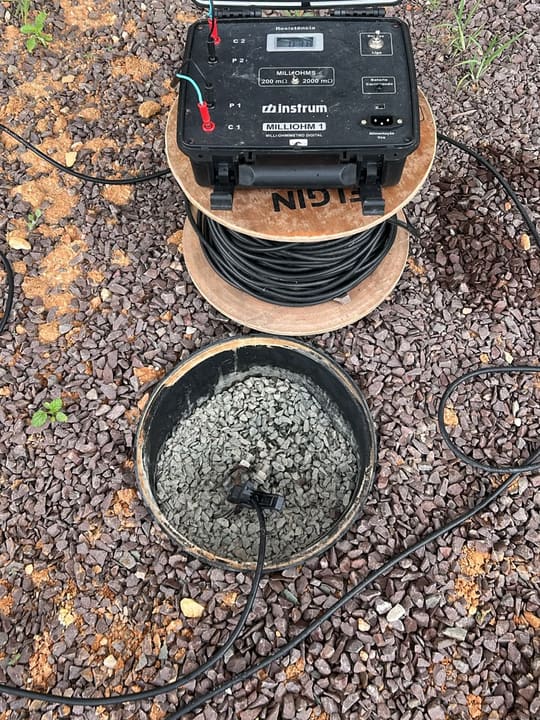
Real record of a test performed by LAMP, with a digital milliohmmeter.
We measure the continuity and grounding resistance of the SPDA with a digital milliohmmeter, connected directly to the grounding well. The result shows whether the system is within the project's parameters — and whether anything needs maintenance before it becomes a problem.
A lightning strike without a safe path to ground can cause fire, structural damage and risk to people inside the building.
Surges associated with lightning strikes damage electrical and electronic installations — from servers to automation systems.
An SPDA isn't "install and forget": grounding resistance needs to be measured periodically to make sure the system is still protecting.
What clients ask us most about SPDA.
That is answered by the risk assessment set out in NBR 5419, which weighs the type of construction, its occupancy, its contents and its exposure. It is not something to answer over the phone by looking at a façade — which is exactly why it belongs to the design stage rather than to guesswork.
Most likely yes: verification. An SPDA is not an install-and-forget system. The earthing lives with corrosion, moisture and changing soil conditions, and the resistance that was correct at handover may not be correct now. Periodic testing is what reveals that before the lightning does.
It is the measurement, using a digital milliohmmeter connected to the earthing pit, of the system's continuity and resistance. The result shows objectively whether the SPDA is still within its design parameters — or whether some part of it has lost electrical contact with the ground.
Not on its own, and this is a common confusion. The air terminals and earthing protect the structure, carrying the discharge safely to ground. Protecting electrical and electronic equipment from the associated surges is Part 4 of NBR 5419: coordinated surge protective devices in the distribution boards. We design both together — and an installation may have solved one and not the other.
See full contact details on the home page.
Engineers of record Page maintained by LAMP Soluções, electrical, mechanical and solar engineering, based in Itabaiana, Sergipe, Brazil. The company's engineers of record: Hertes Garcia, electrical engineer, and Aline Garcia, mechanical engineer — both registered with CREA.