
00 Mechanical · NR-35
Lifeline design and sizing
A fall protection system designed by a legally qualified professional, with an ART filed, for all work at height above 2 metres.
When it is mandatory
Implementing a Fall Protection System (SPQ, from the Portuguese Sistema de Proteção Contra Quedas) is mandatory for all work at height performed more than 2.00 metres above the lower level, wherever there is a risk of falling, under NR-35, the Brazilian regulatory standard for work at height (items 35.2.1 and 35.6.1).
Its purpose is to prevent accidents and to arrest any fall safely, minimising the forces on both the worker and the structure. The SPQ may be collective (SPCQ), which the standard prioritises, or individual (SPIQ), under item 35.6.3.
Main components and applicable standards
| Element | Function and requirements | Standard |
|---|---|---|
| Anchorage system | Fixed point or line (flexible lifelines, Type C, or rigid lifelines, Type D). | NR-35 (Annex II) / ABNT NBR 16325 |
| Connecting element | Lanyards with energy absorber and sliding or retractable fall arresters. | ABNT NBR 15834 / NBR 14626 / NBR 14628 / NBR 14629 / NBR 15837 |
| Personal protective equipment (PPE) | Full-body harness, adjusted to the worker's body. | NR-35 (item 35.6.9) / ABNT NBR 15836 |
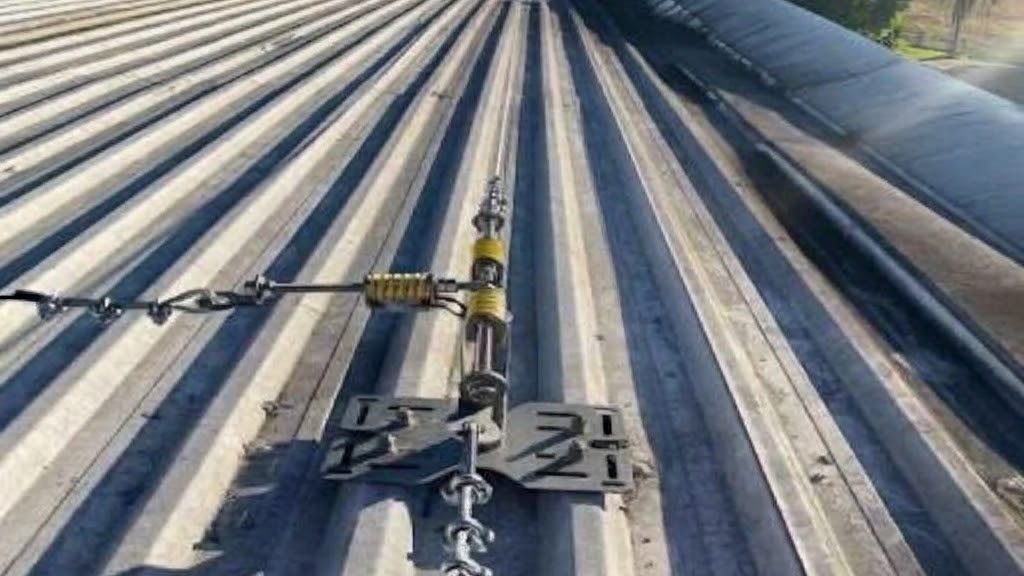
Real record: a lifeline along the ridge of a metal roof. Anchorage, tensioner and connecting elements are sized in the design, not improvised on site.
Designed by a qualified professional
NR-35 requires the SPCQ to be designed by a Legally Qualified Professional (PLH, Profissional Legalmente Habilitado), meaning one registered with the professional council (item 35.6.3.1), taking into account mechanical strength, the Free Fall Zone (ZLQ, Zona Livre de Queda) and the periodic inspection of every component. The standard does not fix the discipline. At LAMP the design is by a CREA-registered mechanical engineer and is delivered with an ART.
Applicable standards: NR-18 (construction), NR-35 (work at height) and ABNT NBR 16325 (anchorage devices).
Questions about lifelines
What clients ask us most before ordering a design.
From what height is a lifeline mandatory?
NR-35 treats any activity performed more than 2 metres above the lower level, where there is a risk of falling, as work at height. In those cases a fall protection system is mandatory.
Flexible or rigid lifeline: what is the difference?
Both are anchorage systems covered by NR-35 (Annex II) and ABNT NBR 16325: the flexible lifeline is Type C and the rigid one is Type D. Which one suits your case is a design decision, taking into account mechanical strength and the free fall zone.
Who can design a lifeline?
A legally qualified professional, meaning one registered with the professional council, as NR-35 requires (item 35.6.3.1). The standard does not fix the discipline; at LAMP the design is by a CREA-registered mechanical engineer, considering mechanical strength, the free fall zone and periodic inspection. At LAMP the design is delivered with an ART (Anotação de Responsabilidade Técnica, the engineer's formal record of responsibility).
Besides the lifeline, what does the worker need?
A connecting element (a lanyard with energy absorber, or a fall arrester) and a full-body harness adjusted to the body, under NR-35 and the ABNT standards listed above.
Request the design of your lifeline
See full contact details on the home page.
Engineers of record Page maintained by LAMP Soluções, electrical, mechanical and solar engineering, based in Itabaiana, Sergipe, Brazil. The company's engineers of record: Hertes Garcia, electrical engineer, and Aline Garcia, mechanical engineer — both registered with CREA.